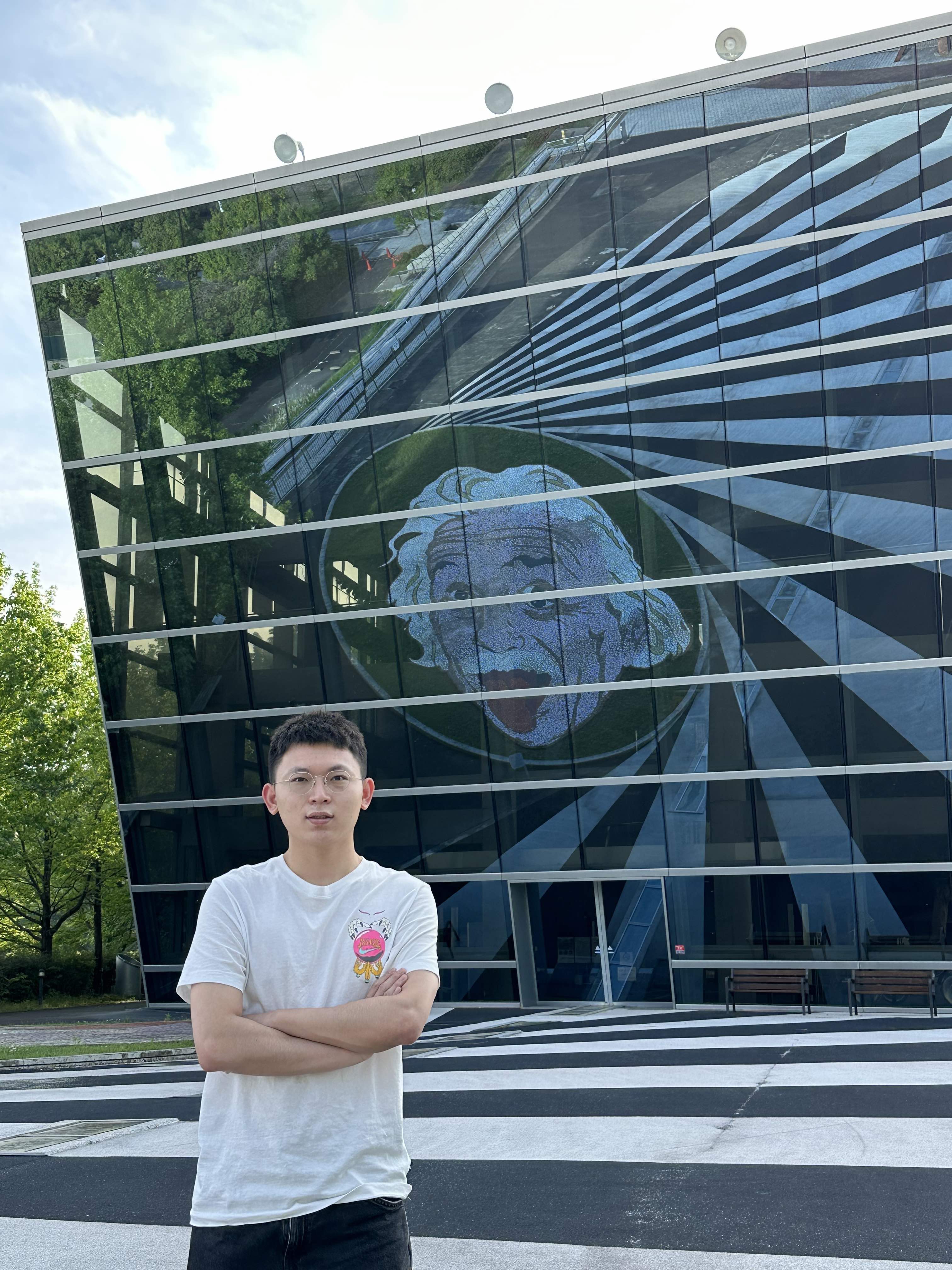
About个人简介
I am an Assistant Professor at Kyushu University, Japan, and a member of the POSL (Principles of Software Engineering and Programming Languages) Lab.
My research focuses on AI-assisted software engineering, particularly how large language models can support code review, software repository analysis, and continuous integration and deployment.
我是日本九州大学助理教授,隶属于 POSL (Principles of Software Engineering and Programming Languages) Lab。
我的研究方向是 AI 辅助软件工程,重点关注大语言模型如何支持代码审查、软件仓库分析以及持续集成与交付。
Research Interests研究兴趣
AI for Software Engineering (AI4SE): The application of artificial intelligence techniques, particularly Large Language Models, to automate and enhance software engineering tasks.
Mining Software Repositories (MSR): Extracting and analyzing data from software repositories to discover patterns, trends, and insights into software development processes.
Continuous Integration & Deployment (CI/CD): The practice of automating the integration and deployment of code changes to optimize build systems and software delivery.
Code Review: The process of systematic examination of computer source code to find bugs, improve code quality, and share knowledge among developers.
人工智能赋能软件工程 (AI4SE): 应用人工智能技术,特别是大语言模型,来自动化和增强软件工程任务。
软件仓库挖掘 (MSR): 从软件仓库中提取和分析数据,以发现软件开发过程中的模式、趋势和洞察。
持续集成与交付 (CI/CD): 自动化代码变更的集成和部署实践,以优化构建系统和软件交付。
代码审查 (Code Review): 系统性检查计算机源代码的过程,旨在发现漏洞、提高代码质量并促进开发者间的知识共享。
Selected Publications代表性论文
How Well Do LLMs Generate Taxonomies in the SE Domain? A Multi-perspective Evaluation Framework
Published in发表于 The 41st IEEE/ACM International Conference on Automated Software Engineering (ASE), 2026
Sota Nakashima, Yuta Ishimoto, Masanari Kondo, Tao Xiao, Yasutaka Kamei [pdf]
View Abstract查看摘要
Taxonomies provide a shared conceptual framework for organizing heterogeneous observations in software engineering (SE) research. Manually constructing such taxonomies is labor-intensive and requires annotators with expertise in the SE domain. While advances in Large Language Models (LLMs) have led to the emergence of automated taxonomy generation methods outside the SE domain, their applicability to technically complex SE artifacts remains unclear. In this experience paper, we present the first comprehensive empirical evaluation of how state-of-the-art automated methods perform on SE artifacts through a multi-perspective evaluation framework, including taxonomy quality, alignment with taxonomies defined by human experts, reliability under independent annotation, and efficiency. To support this evaluation, we systematically collect seven SE papers with publicly available artifacts and human-defined taxonomies, and conduct experiments using two automated methods (TnT-LLM and CLIMB) with five state-of-the-art LLMs. Our evaluation reveals a clear trade-off: TnT-LLM constructs high-quality taxonomies comparable to human-defined ones but incurs substantially higher cost and runtime and tends to generate overly complex taxonomies, whereas CLIMB is 15-40 times faster and 8-49 times cheaper but tends to score lower on quality when technical inference beyond surface-level similarity is required. These findings suggest that TnT-LLM and CLIMB can be used in practical situations in the SE domain, while researchers should first assess the complexity of the generated taxonomies and their cost using a subset of the target data to decide whether to use automated methods or human experts. Our work represents a first step toward a systematic understanding of automated taxonomy generation in SE, offering actionable insights for future research and practice.
Cross-Project Flakiness: A Case Study of the OpenStack Ecosystem
Published in发表于 IEEE Transactions on Software Engineering (TSE), 2026
Tao Xiao, Dong Wang, Shane McIntosh, Hideaki Hata, Yasutaka Kamei [pdf]
View Abstract查看摘要
Automated regression testing is a cornerstone of modern software development, often contributing directly to code review and Continuous Integration (CI). Yet some tests suffer from flakiness, where their outcomes vary non-deterministically. Flakiness erodes developer trust in test results, wastes computational resources, and undermines CI reliability. While prior research has examined test flakiness within individual projects, its broader ecosystem-wide impact remains largely unexplored. In this paper, we present an empirical study of test flakiness in the OpenStack ecosystem, which focuses on (1) cross-project flakiness, where flaky tests impact multiple projects, and (2) inconsistent flakiness, where a test exhibits flakiness in some projects but remains stable in others. By analyzing 649 OpenStack projects, we identify 1,535 cross-project flaky tests and 1,105 inconsistently flaky tests. We find that cross-project flakiness affects 55% of OpenStack projects and significantly increases both review time and computational costs. Surprisingly, 70% of unit tests exhibit cross-project flakiness, challenging the assumption that unit tests are inherently insulated from issues that span modules like integration and system-level tests. Through qualitative analysis, we observe that race conditions in CI, inconsistent build configurations, and dependency mismatches are the primary causes of inconsistent flakiness. These findings underline the need for better coordination across complex ecosystems, standardized CI configurations, and improved test isolation strategies.
Self-Admitted GenAI Usage in Open-Source Software
Published in发表于 IEEE Transactions on Software Engineering (TSE), 2026
Tao Xiao, Youmei Fan, Fabio Calefato, Christoph Treude, Raula Gaikovina Kula, Hideaki Hata, Sebastian Baltes [pdf]
View Abstract查看摘要
The widespread adoption of generative AI (GenAI) tools such as GitHub Copilot and ChatGPT is transforming software development. Since generated source code is virtually impossible to distinguish from manually written code, their real-world usage and impact on open-source software (OSS) development remain poorly understood. In this paper, we introduce the concept of self-admitted GenAI usage, that is, developers explicitly referring to the use of GenAI tools for content creation in software artifacts. Using this concept as a lens to study how GenAI tools are integrated into OSS projects, we analyze a curated sample of more than 200,000 GitHub repositories, identifying 1,292 such self-admissions across 156 repositories in commit messages, code comments, and project documentation. Using a mixed methods approach, we derive a taxonomy of 32 tasks, 10 content types, and 11 purposes associated with GenAI usage based on 1,292 qualitatively coded mentions. We then analyze 13 documents with policies and usage guidelines for GenAI tools and conduct a developer survey to uncover the ethical, legal, and practical concerns behind them. Our findings reveal that developers actively manage how GenAI is used in their projects, highlighting the need for project-level transparency, attribution, and quality control practices in AI-assisted software development. Finally, we examine the longitudinal impact of GenAI adoption on code churn in 151 repositories with self-admitted GenAI usage and find no general increase, contradicting popular narratives on the impact of GenAI on software development.
Generative AI for Pull Request Descriptions: Adoption, Impact, and Developer Interventions
Published in发表于 The ACM International Conference on the Foundations of Software Engineering (FSE), 2024
Tao Xiao, Hideaki Hata, Christoph Treude, Kenichi Matsumoto [pdf]
View Abstract查看摘要
GitHub’s Copilot for Pull Requests (PRs) is a promising service aiming to automate various developer tasks related to PRs, such as generating summaries of changes or providing complete walkthroughs with links to the relevant code. As this innovative technology gains traction in the Open Source Software (OSS) community, it is crucial to examine its early adoption and its impact on the development process. Additionally, it offers a unique opportunity to observe how developers respond when they disagree with the generated content. In our study, we employ a mixed-methods approach, blending quantitative analysis with qualitative insights, to examine 18,256 PRs in which parts of the descriptions were crafted by generative AI. Our findings indicate that: (1) Copilot for PRs, though in its infancy, is seeing a marked uptick in adoption. (2) PRs enhanced by Copilot for PRs require less review time and have a higher likelihood of being merged. (3) Developers using Copilot for PRs often complement the automated descriptions with their manual input. These results offer valuable insights into the growing integration of generative AI in software development.
Education Background教育背景
Doctor of Engineering, Nara Institute of Science and Technology, Japan, 2024
Master of Engineering, Nara Institute of Science and Technology, Japan, 2022
工学博士,奈良先端科学技术大学院大学,日本,2024
工学硕士,奈良先端科学技术大学院大学,日本,2022
Contact联系方式
For inquiries, please contact me at:如有任何问题,请通过以下邮箱联系我:
xiao[AT]ait[DOT]kyushu-u[DOT]ac[DOT]jp